
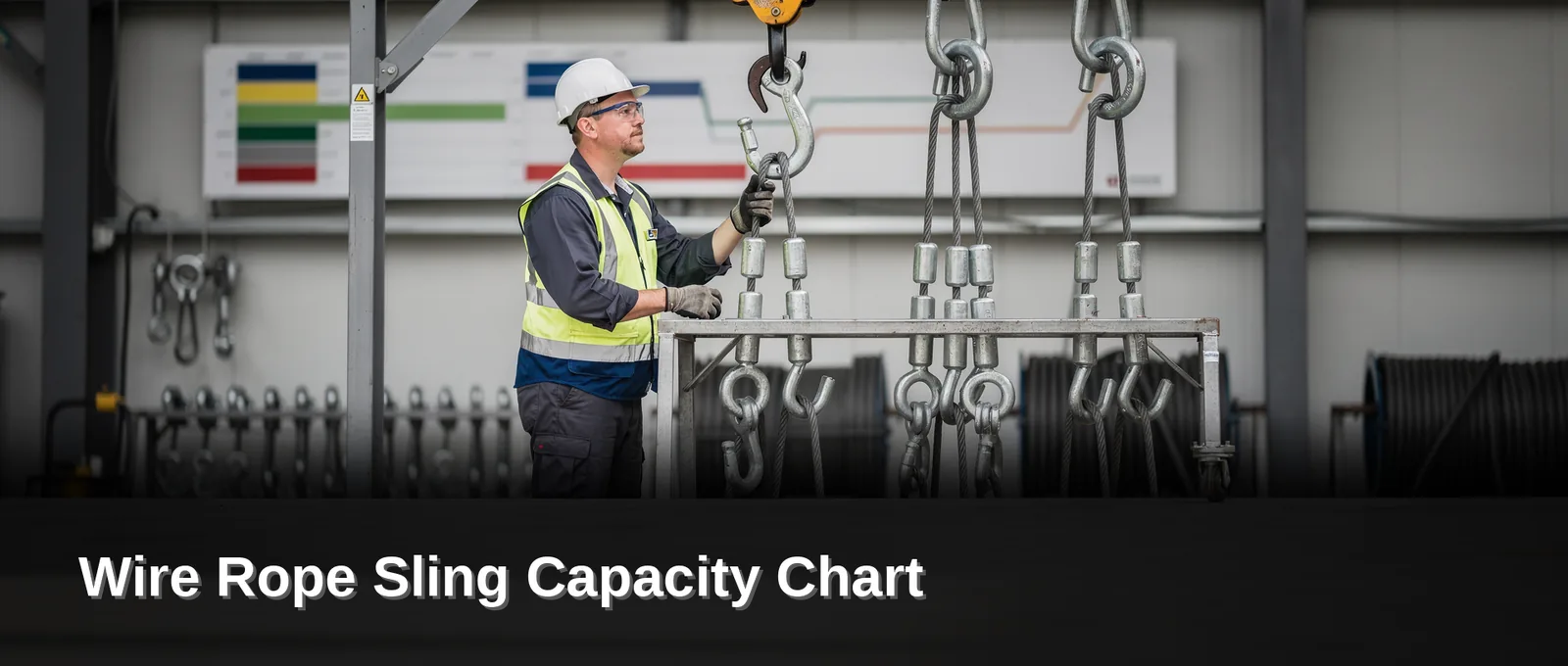
A complete wire rope sling capacity chart from Elko Wire Rope lists working load limits for single-leg and multiple-leg configurations. For example, a 6×19 classification 1/4-inch diameter single-leg sling in a vertical hitch has a 0.65-ton capacity. These charts guide safe lifting in construction and mining.
What is a wire rope sling capacity chart?
A wire rope sling capacity chart defines the maximum safe working load for every sling configuration and rope diameter. Without this reference, rigging crews risk selecting undersized slings that fail under tension. The chart translates engineering specifications into actionable limits that prevent equipment damage and workplace injuries.
How does a capacity chart organize different sling configurations?
The chart separates capacities by hitch type and leg count. A single vertical leg carries one load rating. The same rope in a choker or basket hitch supports a different weight. Multiple-leg bridle slings further adjust capacity based on the horizontal angle between legs.
Each entry pairs a rope diameter with a tonnage limit. A 1/4-inch 6×19 XIP rope in a vertical single-leg configuration carries 0.65 tons. The same rope in a basket hitch supports 1.3 tons. These values shift dramatically as diameter increases or hitch geometry changes.
Why do angle ratings matter on a wire rope sling load chart?
Angle ratings matter because sling tension multiplies as the horizontal angle decreases. A two-leg bridle at 60 degrees distributes load efficiently. At 30 degrees, each leg endures far greater stress. The wire rope sling load chart accounts for this by listing reduced capacities at shallower angles, giving rigging supervisors the data needed to avoid overload conditions.
Professionals in construction and mining consult these charts before every lift. Elko Wire Rope provides manufactured rigging products that meet strict quality standards, and pairing those products with correct chart data ensures safe, defect-free operations. For a deeper breakdown of how working load limits interact with safety factors and environmental variables, the guide on understanding load limits and working load capacities offers essential reference material.
How does sling configuration affect capacity?
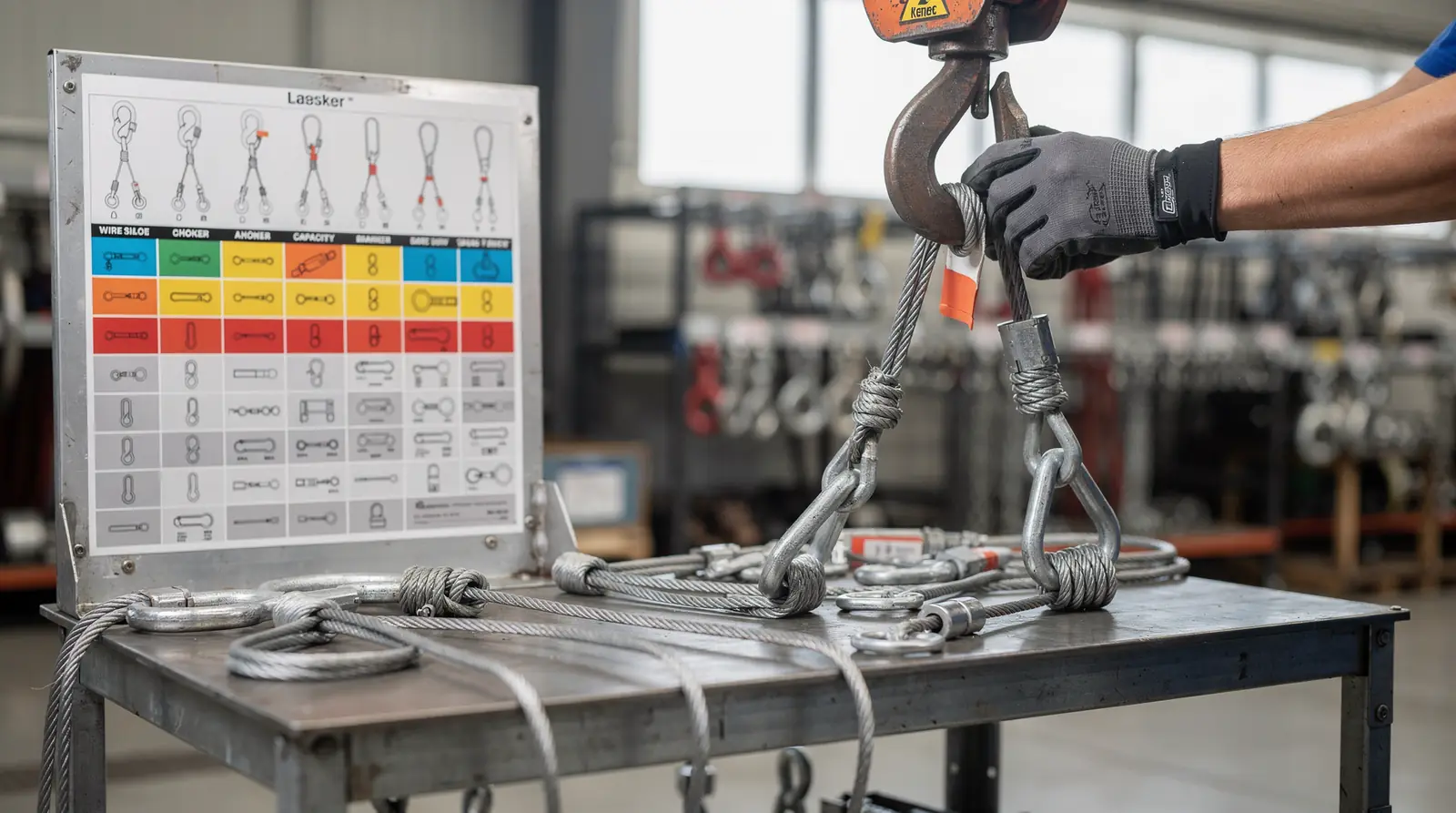
Sling configuration directly determines the safe working load of any wire rope assembly. A single rope diameter carries three distinct capacities depending on whether the hitch is vertical, choker, or basket. Misapplying these values creates a hidden overload condition that compromises lift safety before the load ever leaves the ground.
The wire rope sling capacity shifts dramatically across hitch types. A vertical hitch provides the baseline rating. A basket hitch doubles that vertical capacity because the load distributes across two legs of the rope. A choker hitch reduces capacity because the constriction point concentrates stress on the rope body. Certified Slings & Supply documents this relationship clearly: a 1/4-inch 6×19 wire rope sling carries 0.65 tons vertically, 1.3 tons in a basket configuration, and only 0.48 tons in a choker hitch.
Why does a basket hitch provide higher capacity than a vertical hitch?
A basket hitch supports the load with two rope legs instead of one. The tension divides between both sides, effectively doubling the material available to bear the weight. This configuration works best when the load sits cradled within the sling body rather than hanging from a single attachment point.
How do multiple-leg slings change capacity calculations?
Multi-leg bridle slings introduce angle dependency into the capacity equation. A two-leg sling at 60 degrees carries more weight than the same sling at 30 degrees. The horizontal angle between the legs determines how much tension each leg experiences. Flatter angles multiply the force on individual legs, which is why a wire rope sling load chart always includes angle columns alongside hitch type. Operators who ignore angle reduction factors risk exceeding the working load limit even when the total load weight appears within range.
The wire rope sling capacity chart from Certified Slings & Supply shows these angle effects in precise tonnage values. For a 1/4-inch rope in a two-leg configuration, capacity drops from 1.1 tons at 60 degrees to 0.65 tons at 30 degrees. Three-leg and four-leg assemblies follow the same pattern, with capacity falling as the angle flattens. Elko Wire Rope emphasizes that lifting angles affect sling capacity in ways that demand careful pre-lift calculation. A rigging professional who consults the chart before every lift eliminates the most common cause of sling overload.
What is the working load limit (WLL) for wire rope slings?
The working load limit (WLL) defines the maximum safe load a wire rope sling can handle under normal service conditions. This critical safety threshold prevents catastrophic equipment failure. Operations that ignore the WLL risk dropped loads, structural damage, and severe injury.
How is the WLL determined for a specific sling?
A sling’s WLL is not a single fixed number. It derives from the rope’s construction, its diameter, and the type of core supporting the internal strands. For example, a rope built with an Independent Wire Rope Core (IWRC) provides different strength characteristics than one with a Fiber Core (FC). Elko Wire Rope engineers its products with these variables in mind, ensuring each sling’s capacity matches its intended industrial application.
What happens if a crew exceeds the working load limit?
Exceeding the WLL introduces immediate and serious safety risks. Wire rope slings rank among the most trusted rigging solutions in industrial lifting, but selecting the wrong sling or pushing it past its rated capacity leads directly to equipment failure. A snapped sling under tension releases stored energy violently. Adherence to the manufacturer’s load limits is the single most important factor in preventing these dangerous outcomes on a job site.
How do you read a wire rope sling load chart?
A wire rope sling load chart organizes safe lifting capacities by rope diameter, hitch type, and sling angle. Operators who misread these charts risk catastrophic equipment failure and life-threatening accidents on the job site.
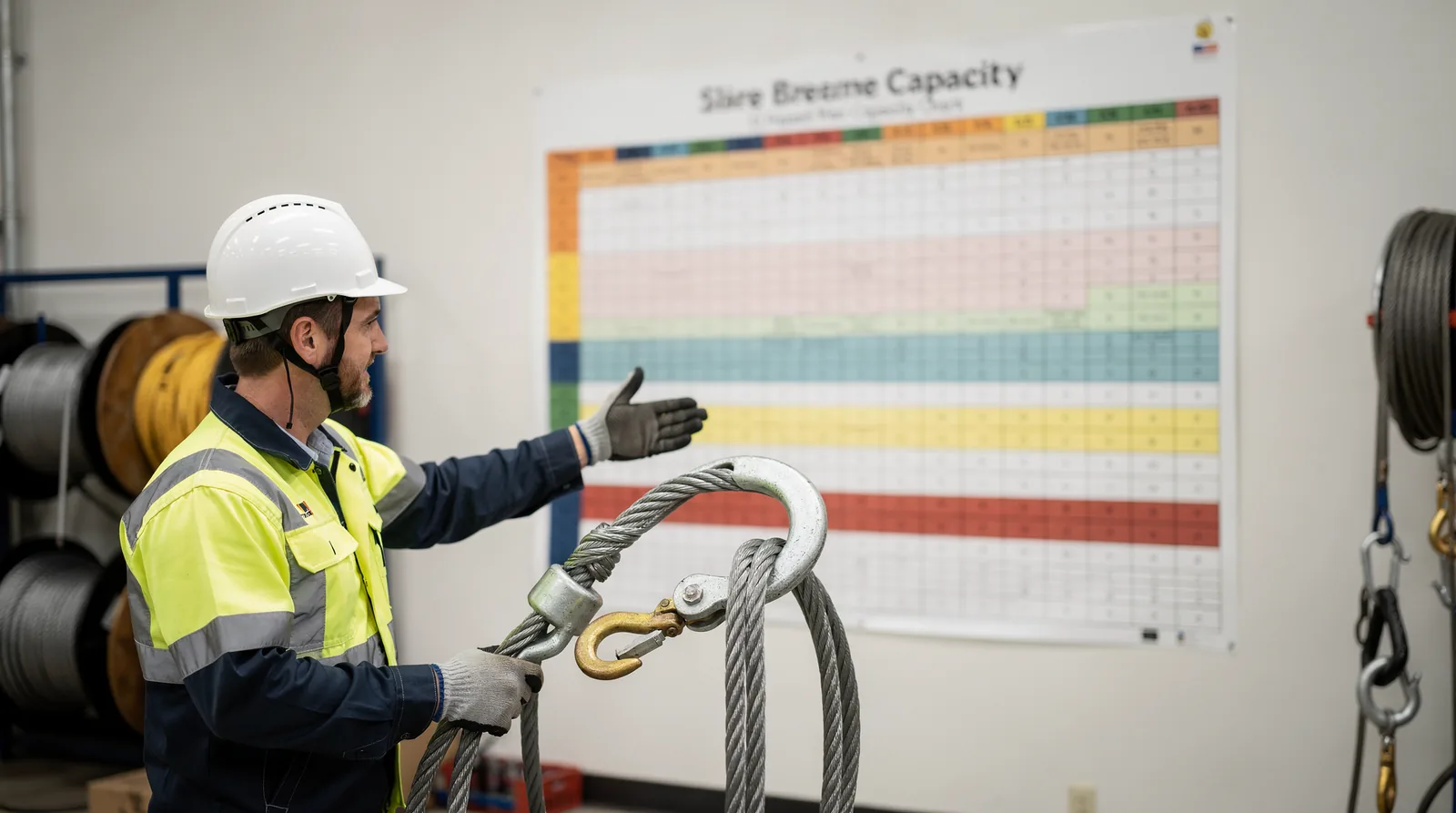
The chart structure follows a logical grid. Rope diameters run down the leftmost column, typically starting at 1/4 inch and increasing to larger industrial sizes. Across the top, columns separate single-leg configurations from multiple-leg assemblies. Each intersection shows the maximum load in tons that a specific rope diameter handles under a given configuration.
What do the vertical, choker, and basket columns mean?
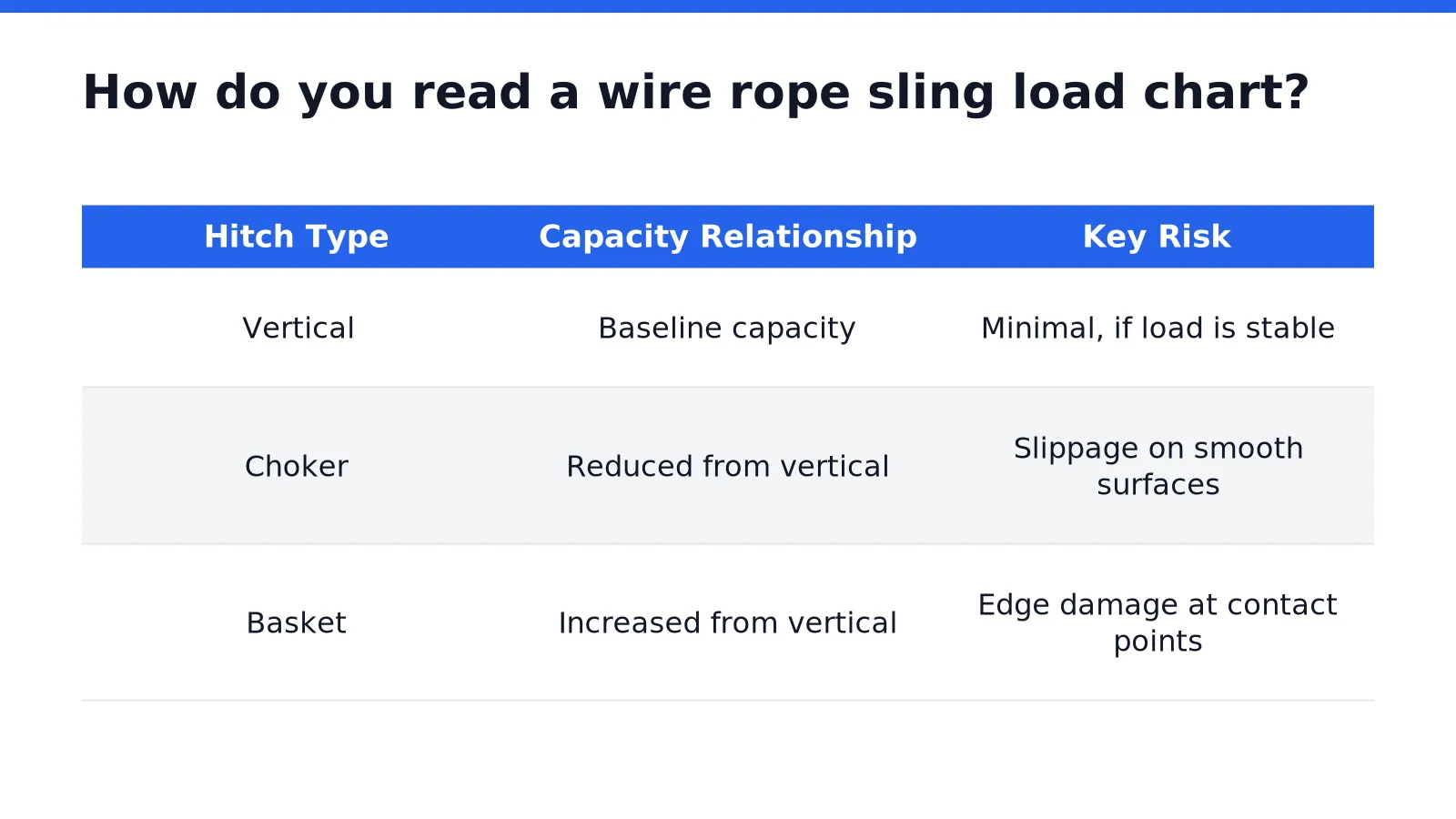
These three columns represent the primary hitch methods used in rigging operations. A vertical hitch supports the load straight up and down, delivering the baseline capacity. The choker hitch wraps around the load and tightens under tension, reducing capacity compared to vertical lifting. A basket hitch cradles the load from underneath, effectively doubling the vertical capacity because the rope shares the weight across two legs.
How do angle ratings affect multiple-leg sling capacities?
Angle ratings appear prominently in wire rope sling capacity tables for two-leg, three-leg, and four-leg configurations. The chart lists capacities at 60 degrees, 45 degrees, and 30 degrees from horizontal. As the angle decreases, the tension on each leg increases dramatically. A two-leg sling at 30 degrees carries far less than the same sling at 60 degrees. Ignoring angle derating turns a properly selected sling into an overloaded hazard.
A wire rope sling capacity chart also includes approximate loop sizes for each rope diameter. This detail matters when clearance around the attachment point is tight. Elko Wire Rope supplies slings manufactured to these exacting standards, ensuring every chart value reflects real-world performance under controlled conditions.
What safety factors apply to wire rope sling use?
Safety factors are built into every wire rope sling capacity rating to account for dynamic loads, wear, and environmental conditions. The working load limit (WLL) represents a fraction of the sling’s ultimate breaking strength. Exceeding that limit invites catastrophic failure.
A wire rope sling load chart translates these safety margins into actionable numbers. Operators who ignore the chart risk equipment damage, load drops, and serious injury. The margin between a successful lift and a failure often comes down to respecting the WLL for the specific sling configuration in use.
Why is the working load limit lower than the breaking strength?
The WLL incorporates a design factor that absorbs real-world variables. Shock loading, angular stress, and gradual abrasion all reduce a sling’s effective strength over time. A sling rated for 2,900 pounds in a basket hitch does not retain that capacity when bent around a sharp corner or exposed to corrosive conditions.
How do manufacturing standards affect sling safety?
Elko Wire Rope products adhere to stringent manufacturing standards that ensure consistency and reliability in lifting operations. These standards govern material selection, fabrication tolerances, and proof testing. A sling built without such controls introduces unpredictable failure points that no wire rope sling capacity chart can account for.
Operators should always consult the capacity chart and never exceed the WLL for the specific sling configuration in use. A vertical hitch, choker hitch, and basket hitch each impose different stress distributions on the rope. Selecting the wrong sling for the lift angle compounds risk. The company provides manufactured rigging products engineered to meet these demands. Even the strongest sling is only as safe as its application.
Conclusion
A rigging professional who consults the capacity chart before every lift eliminates the most common cause of sling overload. Selecting the correct hitch type and angle for the load, and never exceeding the working load limit, transforms a chart from a reference into a daily safety tool. The margin between a successful lift and a failure depends on this single decision.