A shackle is the U-shaped link that joins a sling, chain or wire rope to the load or the hook. Picking one comes down to three choices: the body shape (bow or D), the pin type (screw, bolt or round), and the size that carries your load at the angle you're rigging. This guide covers all three, with a working load limit chart, the side-loading reductions from ASME B30.26, and the signs that mean a shackle comes out of service.
Quick answer: use a bow (anchor) shackle when more than one sling leg or an angled load sits in it, and a D (chain) shackle for straight, in-line pulls. Use a bolt-type pin for anything long-term or vibrating, and a screw pin for rigging you connect and disconnect often.
Parts of a shackle
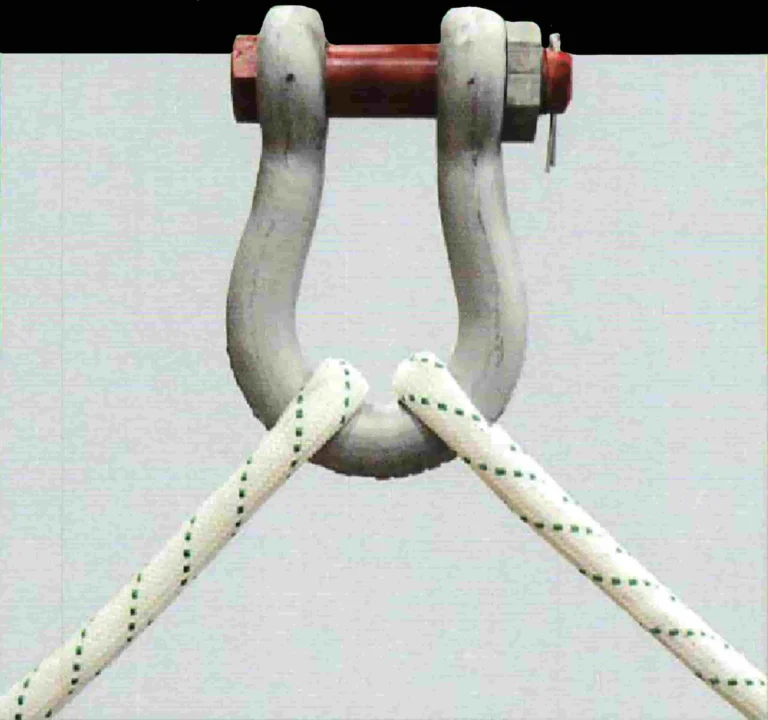
- Body (bow): the U or D-shaped part that carries the load.
- Ears: the two eyes at the open end that the pin passes through.
- Pin: closes the shackle. Screw pins thread into one ear; bolt-type pins pass through and are held with a nut and cotter.
- Markings: every rated shackle is forged or stamped with the manufacturer, size and working load limit (WLL). No legible WLL, no lift.
Shackle body types
Bow (anchor) shackles
The bow has a wide, rounded "O" shape. That extra room lets it take loads from more than one direction, so it's the shackle to use as a collector for two-, three- or four-leg slings, for angled picks, and anywhere the load may shift. Keep multi-leg slings on the bow, not the pin, and keep the included angle between legs at 120° or less.
D (chain) shackles
The D shape is narrower with straight sides. It's built for straight-line tension: a single sling to a lifting lug, a chain to an anchor point, a fixed tie-down. Don't side-load a D shackle. The narrow body twists and deforms when pulled off-line.
Specialty shackles
- Wide body / synthetic sling shackles: a broad, flat bow spreads the load across a round sling or web sling so it doesn't bunch or pinch. With wire rope, a wide body improves the bend ratio (D/d), which extends sling life.
- Long reach shackles: extra length to reach thick pick points and connections.
- Sheet pile shackles: a pin that opens easily but can't drop out, made for driving and pulling sheet piling.
- Snap shackles: quick-release, mostly marine and sailing. Not used for overhead lifting.
Pin types
| Pin | How it closes | Best for | Watch out for |
|---|---|---|---|
| Screw pin | Pin threads into one ear | Rigging that's connected and disconnected often | Can back out under rotation or vibration. Tighten fully before every lift; mouse it if it stays rigged |
| Bolt type | Bolt, nut and cotter pin | Long-term or permanent rigging, vibration, loads that can rotate the pin | Slower to rig. Always replace the cotter pin; never substitute a bolt from the hardware store |
| Round pin | Unthreaded pin held by a cotter | Tie-downs, towing, static in-line loads | Not for overhead lifting and not for side loads or multi-leg slings |
Only use the pin that came with the shackle. Pins are matched to the body and its rating; a mixed or replacement pin voids the rating.
Shackle working load limit chart
Typical working load limits for standard carbon steel bow shackles at a 6:1 design factor, measured by the diameter of the bow. Alloy shackles, including the Green Pin Super line, carry more at the same size. Always rig to the WLL stamped on the shackle in your hand.
| Nominal size (in) | WLL (metric tons) | WLL (lbs, approx.) |
|---|---|---|
| 3/16 | 0.33 | 730 |
| 1/4 | 0.5 | 1,100 |
| 5/16 | 0.75 | 1,650 |
| 3/8 | 1 | 2,200 |
| 7/16 | 1.5 | 3,300 |
| 1/2 | 2 | 4,400 |
| 5/8 | 3.25 | 7,150 |
| 3/4 | 4.75 | 10,450 |
| 7/8 | 6.5 | 14,300 |
| 1 | 8.5 | 18,700 |
| 1-1/8 | 9.5 | 20,900 |
| 1-1/4 | 12 | 26,450 |
| 1-3/8 | 13.5 | 29,750 |
| 1-1/2 | 17 | 37,450 |
| 1-3/4 | 25 | 55,100 |
| 2 | 35 | 77,150 |
| 2-1/2 | 55 | 121,250 |
Size the shackle to the weakest piece of the rigging, not just the load. If a shackle connects a sling, its WLL should meet or beat the sling's rated capacity in the hitch you're using. Need the sling side of the math? See our wire rope sling capacity guide and round sling capacity chart.
Side loading: how much capacity you lose
A shackle is rated for an in-line pull through the centerline of the bow and pin. Pull it off-center and its capacity drops. ASME B30.26 gives these reductions for screw pin and bolt-type bow shackles:
| Angle off the centerline | Usable WLL |
|---|---|
| 0° to 5° (in-line) | 100% |
| 6° to 45° | 70% (30% reduction) |
| 46° to 90° | 50% (50% reduction) |
| Over 90° | Do not load this way |
Example: a 3/4" bow shackle rated 4.75 t, pulled at 30° off-line, is good for about 3.3 t. Sling angle stacks on top of this. Flatter sling legs pull harder on the shackle; at a 30° horizontal sling angle each leg sees twice its share of the load. Our guide to how lifting angles affect sling capacity walks through the math.
Shackle materials
- Carbon steel: the standard for general lifting, usually rated at a 6:1 design factor. Forgiving: it stretches visibly before it fails.
- Alloy steel: stronger, so you get the same WLL in a smaller, lighter shackle. Common for high-capacity and tight-clearance picks.
- Galvanized: zinc coating for outdoor and mining use. Good corrosion resistance for the price.
- Stainless steel: best corrosion resistance for marine, food and chemical environments. Check the rating; stainless shackles often carry a lower WLL than the same size in alloy.
When to remove a shackle from service
Inspect every shackle before each use. Under ASME B30.26, take it out of service if you find any of these:
- Missing or unreadable manufacturer name or WLL
- Wear of 10% or more of the original dimension at any point, on the bow or the pin
- A bent, twisted, stretched or elongated body, or ears that are no longer in line
- Cracks, deep nicks or gouges
- Heat damage, weld spatter, or any sign of welding or grinding
- Heavy pitting or corrosion
- A pin that won't seat fully, or damaged threads
- A replacement pin that isn't from the original manufacturer
Heavy-use shackles may need daily checks, and harsh conditions like mines, salt and heat call for more frequent periodic inspections. When in doubt, cut it out: a shackle costs far less than a dropped load. For a full pre-lift routine, use our rigging equipment checklist.
Using shackles safely
- Confirm the stamped WLL covers the load at the angle you're rigging.
- Seat a screw pin fully, shoulder tight against the ear. Never back it off to line it up with the load.
- Put the pin on the hook or fixed point and let the sling ride the bow, so the sling can't rotate the pin loose.
- Center the load in the bow. Don't let it ride up one side.
- Use spacers or washers to center a narrow load on the pin, not to make up for a too-big shackle.
- Never replace a pin with a bolt, weld a shackle, or heat it to bend it.
Shackles we stock
Elko Wire Rope stocks forged shackles from Green Pin and CM, built and certified to recognized lifting standards:
- Green Pin Bow Shackle SC G-4161 (screw collar pin)
- Green Pin Bow Shackle BN G-4163 (bolt, nut and cotter)
- Green Pin Super Bow Shackle SC G-5260 (high-strength alloy, screw pin)
- Green Pin Super Bow Shackle BN G-5263 (high-strength alloy, bolt type)
- CM Screw Pin Super Strong and CM Bolt Type Super Strong
Browse the full shackle lineup, or send us the load, the sling and how you're rigging it. Our branches in Salt Lake City, Elko, Phoenix and Safford will match the shackle to the job.
Lifting Shackle FAQs
What is the difference between a bow shackle and a D shackle?
A bow (anchor) shackle has a rounded body that handles loads from several directions and multiple sling legs. A D (chain) shackle has a narrow, straight-sided body meant only for straight-line pulls.
Which shackle is best for overhead lifting?
A rated screw pin or bolt-type bow shackle sized to the load. Use bolt type if it will stay rigged or see vibration. Never use a round pin shackle or a snap shackle for overhead lifting.
How do I know what size shackle I need?
Find the load on that connection, including sling angle and any side loading, then choose a shackle whose stamped WLL meets or exceeds it. Match it to the rated capacity of the sling it connects.
Can you side load a shackle?
Bow shackles can be side loaded with reduced capacity: 70% of WLL at 6–45° off-line and 50% at 46–90°. D shackles should not be side loaded.
When should a shackle be thrown out?
When it has 10% or more wear at any point, any bend, twist, crack or heat damage, a missing or unreadable WLL, damaged threads, or a pin that isn't the original. Inspect before every lift.
What does WLL mean on a shackle?
Working load limit: the maximum load the shackle is rated to lift in a straight, in-line pull. Its minimum breaking strength is several times higher (the design factor), but you never rig past the WLL.