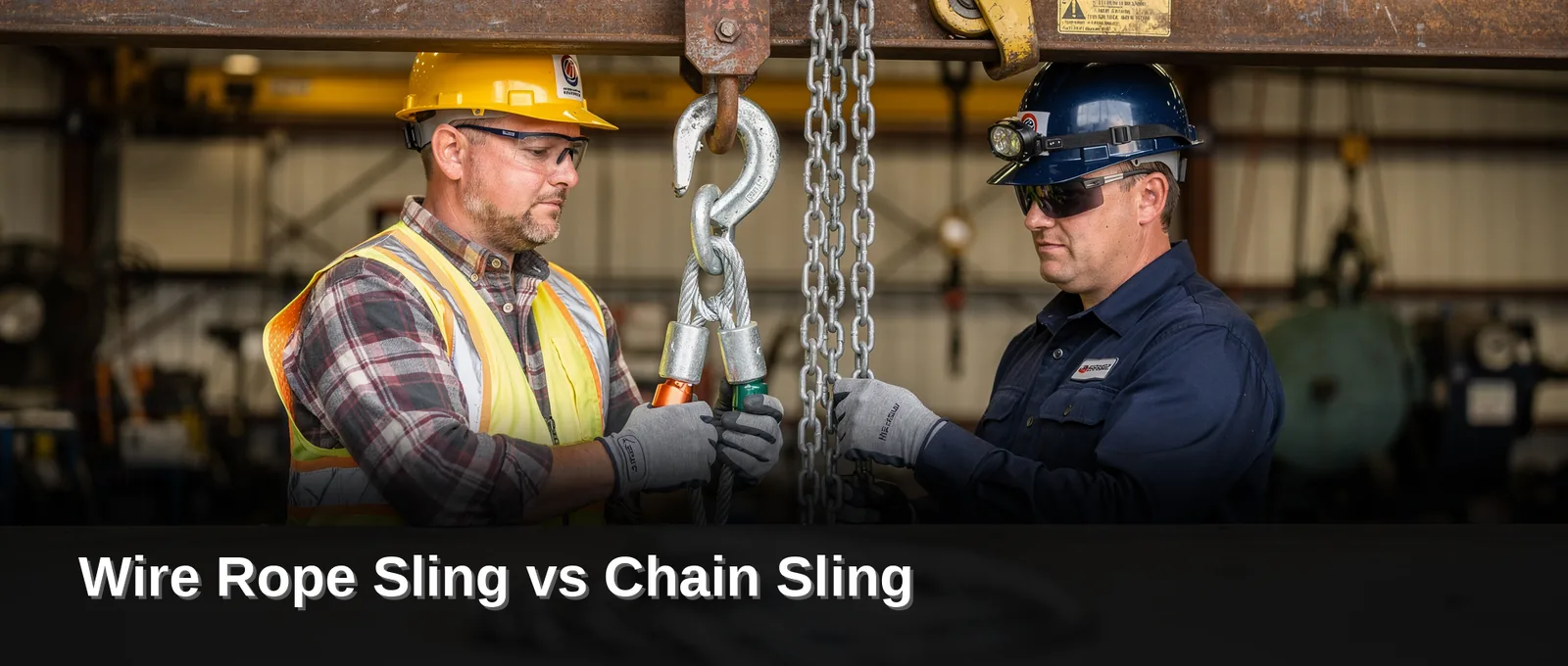
Wire rope slings offer superior flexibility and abrasion resistance for general lifting. Chain slings provide greater strength in high-heat or cutting environments. Elko Wire Rope supplies both options for industrial rigging, construction, and mining applications. Selection depends on load weight, temperature exposure, and operational conditions.
What Are the Core Differences Between Slings?
The core differences between slings center on material composition, durability, and ideal application. A wire rope sling vs chain sling comparison reveals distinct trade-offs in heat tolerance and surface protection. Synthetic options prioritize load preservation.
How does wire rope sling construction affect performance?
Wire rope slings are constructed from individual strands of steel wire laid in a helical pattern around a fiber or steel core. This design provides a combination of strength and flexibility. The construction of wire rope, including strand count and core type, determines its balance of durability, flexibility, and resistance to wear. Operators selecting rigging for abrasive mining environments often reference a guide to wire rope 101 terminology to understand these structural variables.
What are the primary advantages of synthetic slings?
Synthetic slings are made from high-strength fibers such as nylon or polyester. These slings are designed for safe, damage-free load handling. Their light weight and pliable nature make them the preferred choice for protecting finished surfaces during lifts.
What role do connectors play in sling systems?
A shackle is a U-shaped connector made from high-strength forged steel that joins rigging hardware to the load. Every shackle carries a Working Load Limit. This component is critical for creating a secure link between the sling and the lifted object. Elko Wire Rope supplies these connectors to ensure system integrity across all sling types.
How Do Wire Rope and Chain Slings Compare?
Wire rope and chain slings both handle heavy lifting in construction, mining, and manufacturing environments. Their performance characteristics diverge sharply under specific job-site conditions. The critical difference rests in how each material responds to heat, abrasion, and dynamic loads. A field manager who selects the wrong sling type for a hot-metal pour or a corrosive outdoor lift trades safety margins and service life for a lower upfront cost.
What Environmental Factors Favor a Wire Rope Sling vs Chain Sling?
A wire rope sling vs chain sling decision hinges first on the work environment. The nature of the load, according to Safety Lifting Gear. Wire rope slings are often selected for durability, heat resistance, long service life, and easy inspection. These characteristics make them the primary choice in foundries, steel mills, and abrasive mining applications. Chain slings offer superior flexibility in tie-down configurations but degrade faster when exposed to continuous friction or extreme heat without specialized alloy grades. Elko Wire Rope supplies a comprehensive range of rigging products tailored to these demanding conditions.
Which Sling Delivers Better Visibility of Wear and Damage?
Wire rope slings provide clear, externally visible indicators of deterioration. A rigging supervisor checks for broken wires, kinks, or core protrusion during every pre-shift inspection. This transparency contrasts with chain links, where internal stress fractures or stretch remain hidden until a link fails. Construction crews who rely on wire rope slings avoid the hidden failure risk that chain systems carry. The absence of visible wear in a chain does not guarantee structural integrity.
What Role Does Internal Construction Play in Sling Selection?
Wire rope performance depends heavily on construction type. Among the most widely used configurations are the 6×19 and 6×37 constructions, along with core types such as IWRC (Independent Wire Rope Core) and FC (Fiber Core). Elko Wire Rope supplies these variations to match specific lift profiles. A wire rope construction with an IWRC core adds crushing resistance for multi-layer drum winding. A 6×37 classification increases flexibility for sheave-heavy crane setups. Chain slings lack this internal configurability; their load rating changes primarily with link diameter and alloy grade. Operations that require fine-tuned lift characteristics default to wire rope for this reason.
What Are the Types of Wire Rope Sling Hitches?
A wire rope sling hitch defines how the sling connects to and supports a load during lifting operations. The three fundamental hitch types are the vertical hitch, the choker hitch, and the basket hitch, each distributing force differently across the sling body and the load itself.
How Does a Vertical Hitch Work?
A vertical hitch attaches one end of the sling to the lifting hook and the other end directly to the load. This configuration uses the sling’s full rated capacity in a straight pull. Construction and mining crews rely on vertical hitches for lifting loads with a single, top-mounted attachment point.
How Does a Choker Hitch Secure a Load?
A choker hitch wraps the sling around the load and passes one eye through the other, tightening as tension increases. The choker method excels when loads lack dedicated lifting eyes or require a tight, non-slip hold during transport.
How Does a Basket Hitch Distribute Weight?
A basket hitch cradles the load by passing the sling underneath and attaching both eyes to the hook. When the legs remain vertical, this hitch doubles the sling’s vertical capacity. Angled basket configurations reduce that capacity, demanding careful angle calculations from rigging supervisors.
Elko Wire Rope manufactures slings engineered for all three hitch types, with performance that depends heavily on construction factors like strand count and core type. The company’s wire rope slings serve cranes, hoists, winches, and general material handling applications across mining and heavy manufacturing sites.
What Factors Determine the Right Hitch Selection?
The right hitch depends on load weight, surface condition, lift configuration, environment, and inspection requirements. Rigging professionals must also evaluate how the sling interacts with the load to prevent edge damage or slippage. Selecting the correct types of wire rope sling hitches prevents capacity loss and equipment failure. For broader guidance on matching equipment to operational demands, crews can review the principles of choosing the right rigging equipment before finalizing a lift plan.
Which Sling Should Your Operation Choose?
Selecting between a wire rope sling vs chain sling depends on load characteristics, environmental conditions, and inspection requirements. Wire rope slings deliver superior flexibility and fatigue resistance for dynamic lifts. Chain slings offer unmatched durability in abrasive, high-temperature settings. The wrong choice compromises safety and accelerates equipment failure.
What factors determine sling suitability for heavy industrial lifts?
Three operational criteria drive the decision. Temperature tolerance matters first: wire rope slings withstand heat better than synthetic alternatives, though chain slings handle extreme foundry conditions. Abrasion resistance follows, where chain outperforms wire rope in rough-surface lifting. Inspection frequency completes the triad. Wire rope slings reveal wear through broken wires, making visual checks straightforward.
How do types of wire rope sling hitches affect lifting capacity?
Hitch configuration directly alters a sling's working load limit. A vertical hitch uses the full sling capacity. A choker hitch reduces capacity by approximately 25 percent due to the constriction angle. A basket hitch doubles capacity when legs remain vertical, though angled basket configurations decrease that multiplier. Operators must calculate these reductions before every lift.
Elko Wire Rope manufactures high-quality wire rope slings adhering to stringent manufacturing standards. The company's dedication to using domestic USA-made products ensures quality and supports local manufacturing, securing timely deliveries for project success. Service locations across the USA, including Salt Lake City, Elko, Safford, and Phoenix, provide local access to these solutions. A comprehensive assortment of synthetic slings rounds out the offering, designed for load capacity, durability, and safety requirements with competitive pricing and prompt delivery. For operations evaluating specific configurations, the guide on how to choose the right wire rope sling details single-leg and multi-leg options.
Conclusion
The decision between wire rope and chain slings ultimately rests on the specific demands of each lift, from temperature exposure to inspection protocols. Operations requiring flexibility and visible wear indicators will find wire rope superior. Those facing extreme heat and abrasion should prioritize chain. Evaluate these criteria against the lift profile to select the sling that ensures both safety and operational efficiency.